
Inert from pH 0
to pH 14.
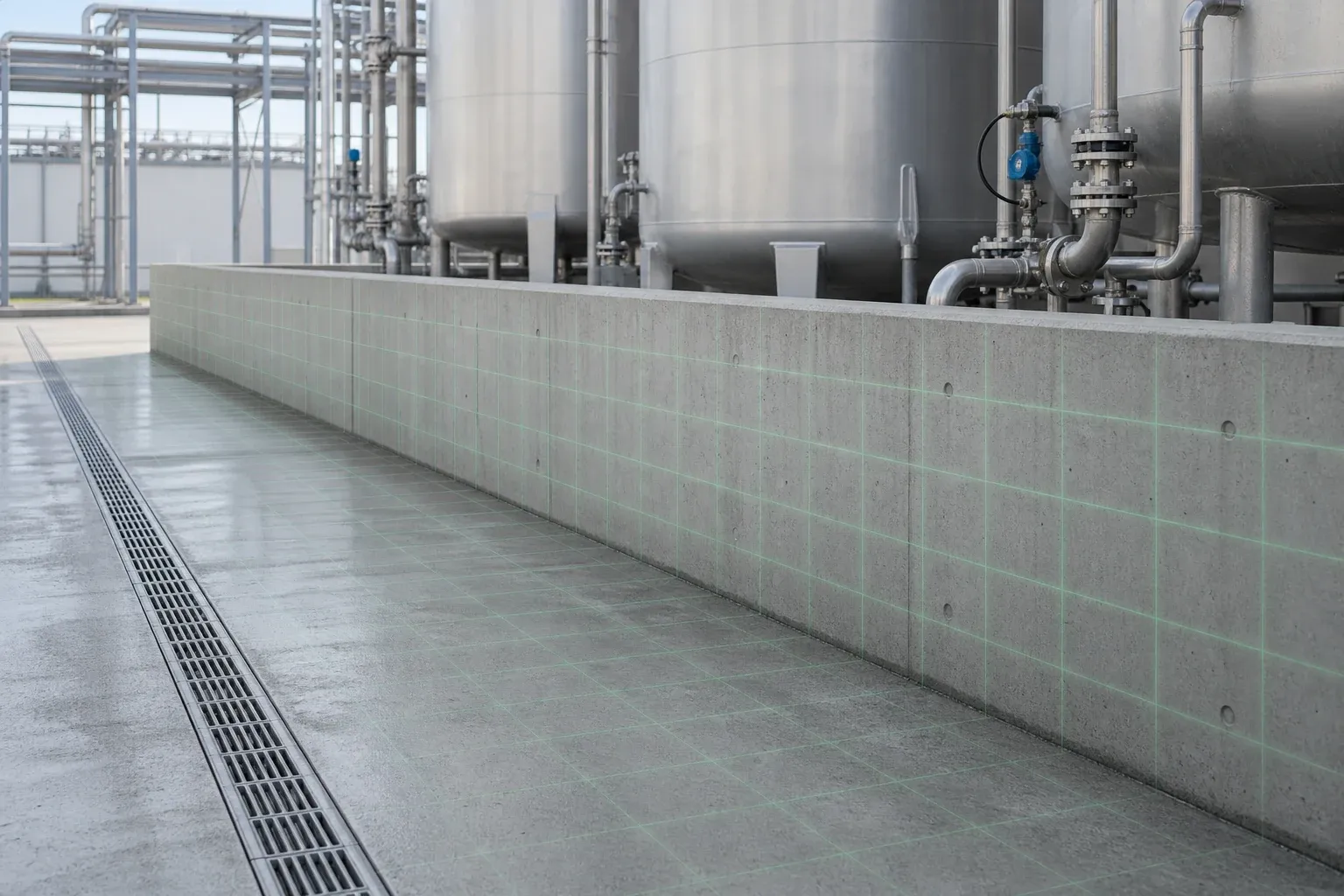
Wastewater treatment plants, mining process floors, fertiliser containment slabs, drainage channels, industrial wash bays. Where the chemistry of the operating environment is the failure mode for steel rebar — and the design has to last beyond it.
When the concrete
can't do the protecting.
Steel reinforcement relies on the concrete around it being alkaline — the high-pH environment passivates the steel surface and keeps it corrosion-protected. In chemical and water infrastructure, the operating environment removes that alkalinity: sulphates leach calcium, acids attack the cement matrix, chlorides depassivate the steel directly. The protection mechanism fails before the structure does.
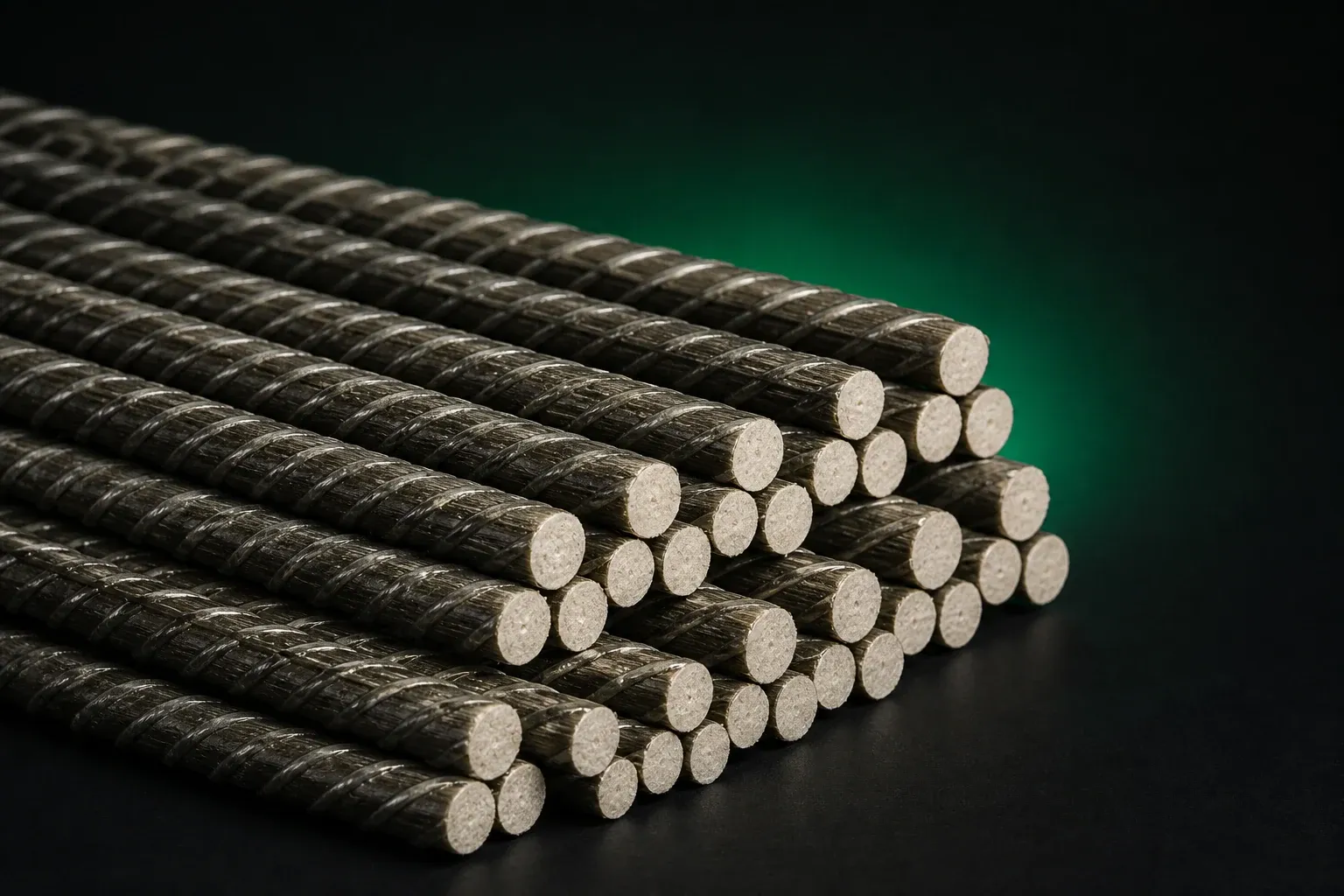
GFRP does not depend on the concrete for protection. The reinforcement is inert across the chloride, sulphate, alkali and acid ranges — it does not contribute to the failure chain in any direction.
Where the reinforcement
holds up.
Steel is corrosion-stable only in a narrow alkaline window — roughly pH 9 to 13, the natural range of fresh concrete. GFRP is chemically inert across the full pH scale. Below: where each reinforcement type belongs.
Outside this band, steel rebar depassivates and active corrosion proceeds. Carbonated concrete drifts toward pH 8 over decades; acid or sulphate attack drives it lower.
Glass fibre + nano-epoxy resin remains chemically stable across the full pH range. Acid plants, alkaline wastewater, neutral drainage water, sulphate-rich soils — none of them are part of the failure chain.
Where the chemistry
decides the design.
Six element families across wastewater, mining, drainage, fertiliser, cooling and food infrastructure — where the design conversation starts with the operating chemistry, not the structural loading.
- 01Wastewater treatment plants
Aeration basins, sludge tanks, primary settling slabs. Sulphates and biological acids attack steel-reinforced concrete in 15–30 years. GFRP is the standard reinforcement specification for new builds.
- 02Mining & process floors
Acid leaching pads, ore processing floors, conveyor foundations. The Jizan flood channel — 21.3 km, world’s largest FRP structure — is the reference for industrial-scale containment.
- 03Drainage channels & culverts
Saline runoff, agricultural acids, urban stormwater. Continuous-coil GFRP delivery reduces installation time by 4× over bent rebar.
- 04Fertiliser & ammonia plants
High-ammonia concentrations and acid spills. GFRP eliminates the chronic spalling cycle that ends most steel-reinforced plant floors at year 20.
- 05Cooling towers & basins
Chemically-treated cooling water and sulphate-laden makeup water. The structural envelope outlives steel rebar by a factor of three.
- 06Aquaculture & food-industry
Saline wash bays, brine tanks, processing plant floors. GFRP is non-leaching and food-safe inside the concrete envelope.
Concrete protects steel rebar by being alkaline. The moment the alkalinity is consumed by acid attack, sulphate ingress or carbonation, steel reinforcement is in the environment the bar was never designed for.
For the design office.
Six notes that come up in chemical-containment cooperations. None of them invalidate the codes — they direct the engineer toward GFRP-appropriate detailing for industrial-chemistry exposure.
- Cover
- EN 1992 minimum for exposure class XA1–XA3. GFRP does not change cover requirements — corrosion is no longer the design driver, but the cover still does its structural job.
- Resin selection
- Nano-epoxy resin is standard. For continuous immersion in concentrated acid or alkali, we run a project-specific chemical compatibility check.
- Bond β
- ≈ 1.0 with helically profiled GFRP per ETA 23/0523 (EAD 260023-00-0301).
- Detailing
- Wastewater treatment slabs typically Ø 12 mm in welded GFRP mesh; fertiliser containment in Ø 12 / 16 mm straight bars.
- Hybrid sections
- Where ductility is mandated (seismic zones, high cyclic load), steel can be retained in the compression zone with GFRP at the chemically-exposed face.
- References
- ACI 440.11-22 + fib MC 2020 §17 + ISO 10406-1. Project-specific assessment via ETA 23/0523 (EAD 260023-00-0301).

