
Where chloride attack
ends steel before
the structure.
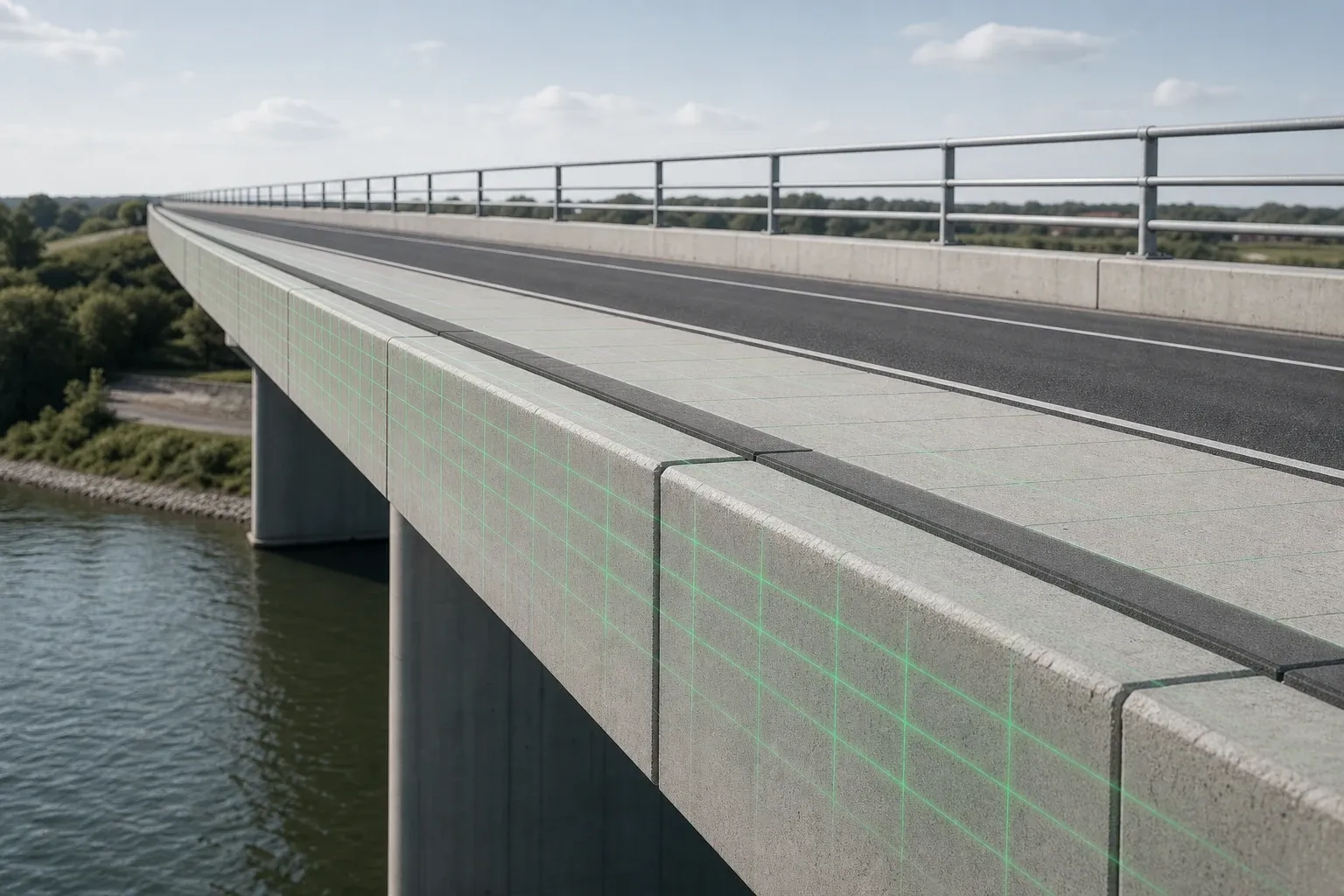
Saltwater piers, sea walls, breakwaters, marine viaducts, port infrastructure. The steel inside the concrete rusts through decades before the structure is worn out. GFRP is the reinforcement that breaks that cycle.
The chemistry that
retires steel rebar.
Concrete is alkaline. While the alkalinity is intact, steel rebar inside it is passivated and corrosion-protected. The problem in coastal infrastructure is that chloride ions migrate through the concrete cover and depassivate the steel. After that, corrosion proceeds at the rate of the available oxygen — quickly. The rust products are roughly six times the volume of the original steel, which spalls the concrete and accelerates further ingress.
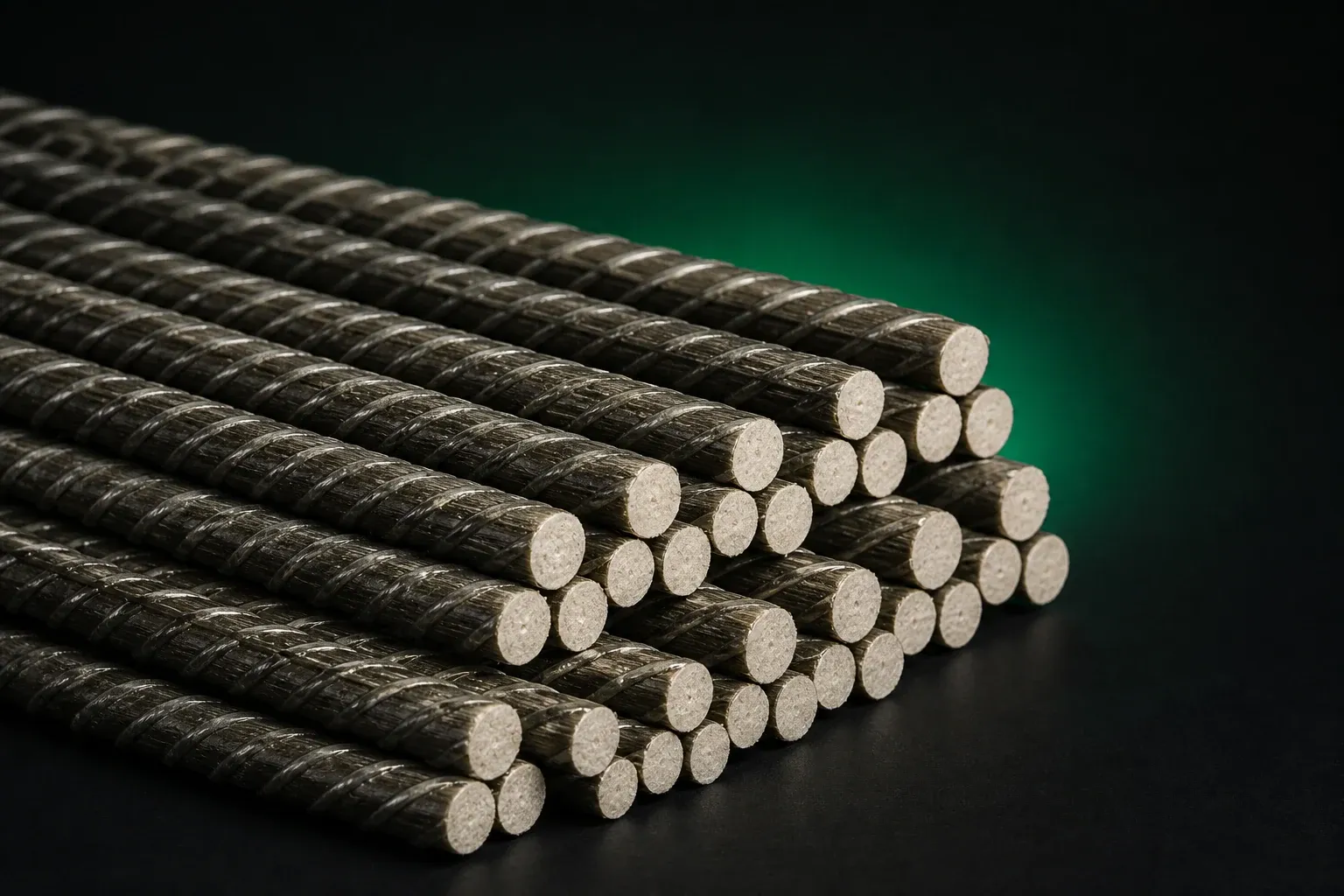
GFRP is glass fibre in a thermoset resin matrix. It does not contain iron. There is no rust reaction; there is no expansion; there is no spalling. The concrete cover only has to do its structural job, not its corrosion-protection job.
What happens
over the next forty years.
Five phases of a typical coastal structure's life — what happens to steel reinforcement, and to GFRP in the same environment.
Phase boundaries are typical for a 50 mm cover, ~ 350 kg/m³ cement, exposed coastal atmosphere. Project-specific lifecycle modelling is part of every cooperation.
Where GFRP gets
specified in coastal work.
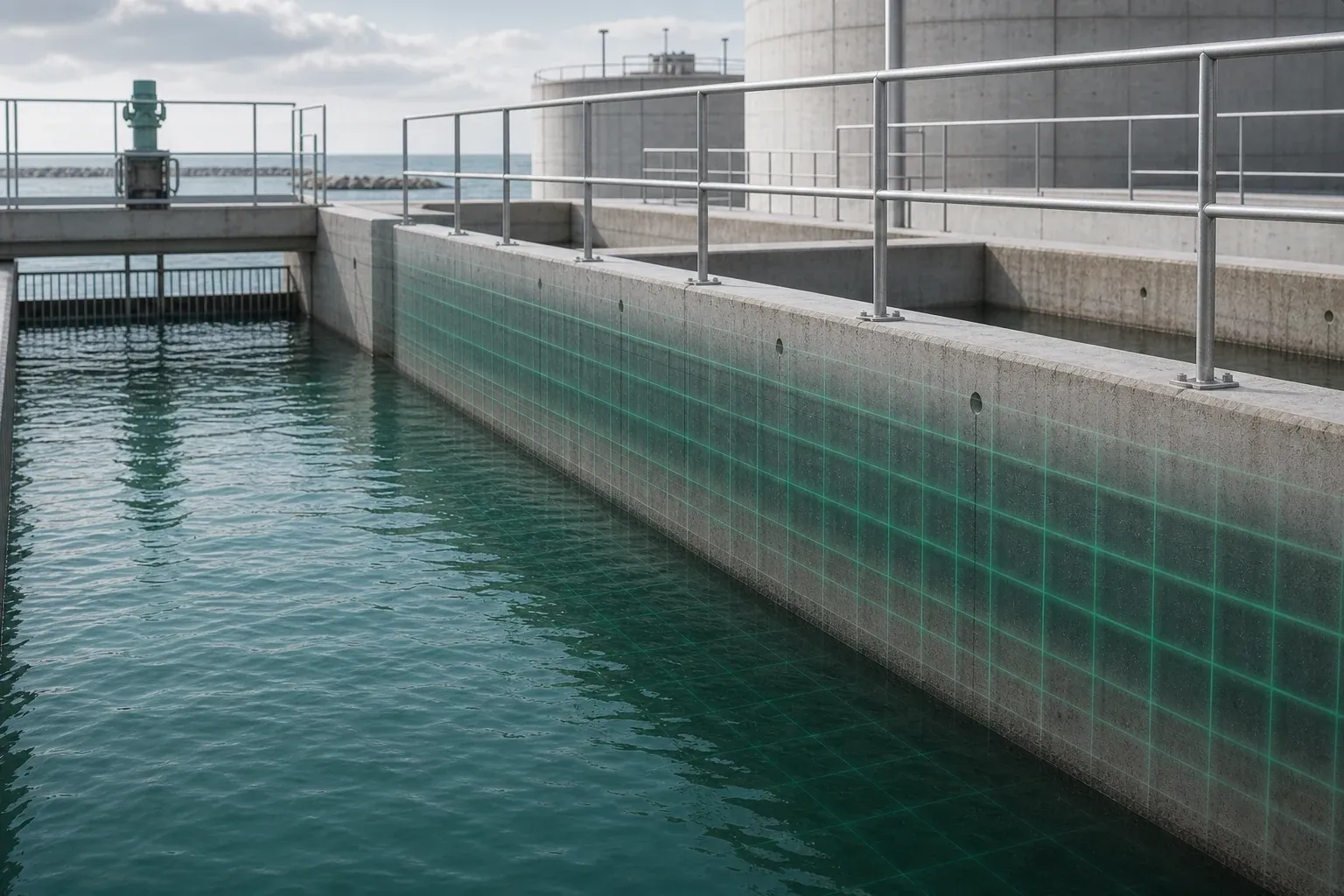
Four element families account for most of our coastal shipping list. Each is specified slightly differently — often hybrid with steel.
- 01Pier-caps & headstocks
Direct salt-spray exposure. Often the first element where the corrosion allowance runs out. GFRP changes the inspection regime entirely.
- 02Sea walls & breakwaters
Cyclical wave loading plus chloride saturation. Hybrid sections with steel inside, GFRP at the salt-exposed face.
- 03Deck slabs
Marine viaducts with chloride spray and standing rainwater. Top mat in GFRP, often bottom mat retained in steel for ductility.
- 04Parapets & barriers
Salt spray + impact loading + increasingly embedded sensors. Triple advantage for GFRP.
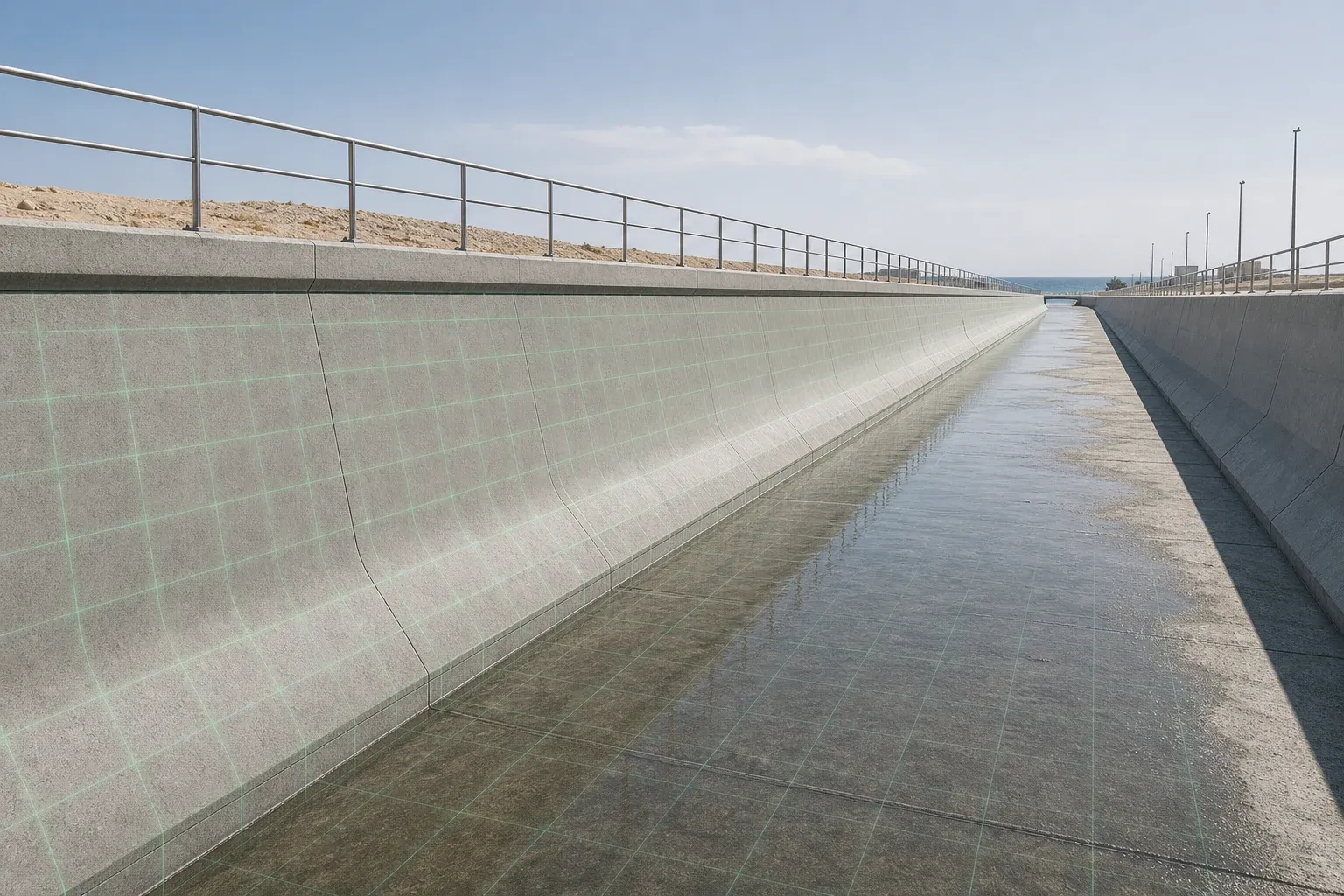
The world's largest FRP-reinforced concrete structure.
A 21.3 km flood-control channel exposed to salt water, sand and intense heat. After lifecycle modelling of chloride attack compared with steel, GFRP was specified across the entire run. Documented by the American Concrete Institute.
In coastal infrastructure, the dominant failure mode is not structural capacity — it is the corrosion of the steel inside the concrete.
For the design office.
Six notes that come up in almost every coastal cooperation. None of them invalidate the codes — they direct the engineer toward GFRP-appropriate details.
- Cover
- As per EN 1992 minimum cover for environmental class. No additional cover required for GFRP — corrosion is not a cover-design constraint.
- Bond β
- ≈ 1.0 with helically profiled GFRP per ETA 23/0523 (EAD 260023-00-0301).
- Diameter selection
- Coastal pier-cap and parapet work most commonly specifies Ø 12 / Ø 16 mm. Ø 12 mm appropriate for slab top mat.
- Hybrid sections
- Steel inner mat + GFRP exposed face is the most common detail in retrofit and refurbishment work.
- Anchorage
- Hook geometry limited to Ø 12 mm and below; straight anchorage with adequate length is preferred for Ø 16+ mm.
- Code reference
- ACI 440.11-22 + fib MC 2020 §17.5 for design. Project-specific lifecycle model run in step one of the cooperation.

