
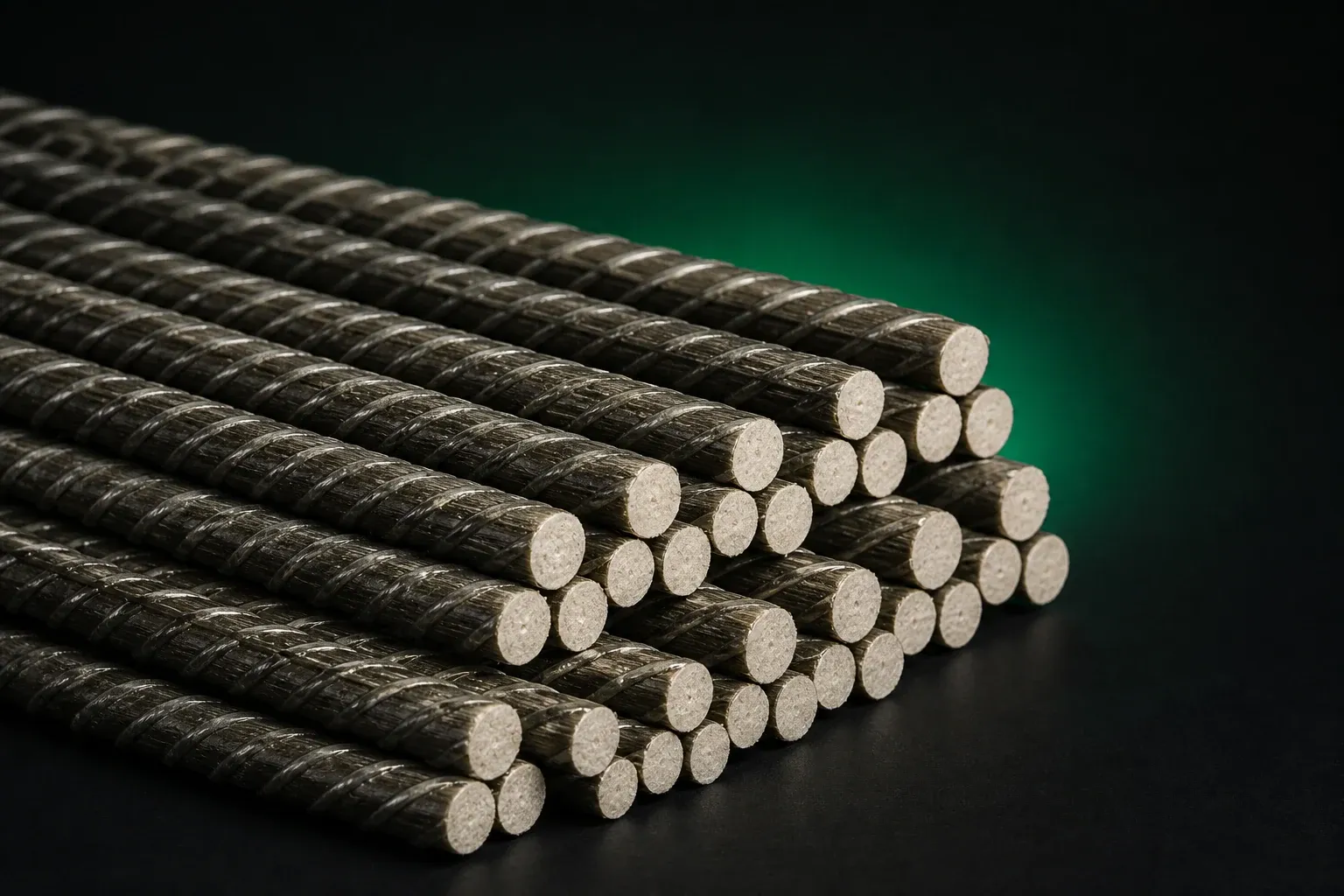
GFRP rebar.
Glass fibre reinforced polymer reinforcement for concrete — corrosion-free, lighter than steel, and built to outlast the structures it sits in.
- −70 %
- CO₂ vs steel
- 80+ yr
- service life
- 2.4×
- tensile vs steel
- Ø 6–16 mm
- certified diameters
What it does
differently.
Six reasons to choose GFRP when steel wouldn't last the life of the structure — or when carbon is part of the spec.
- Corrosion-free
It doesn't rust in salt, chemicals or moisture — the most common reason concrete structures fail.
- Lower carbon
Up to 70 % less CO₂ in production than steel rebar. Earns LEED, BREEAM and DGNB credits.
- Built to last
80+ years of service inside concrete. Outlives most of the buildings being designed today.
- Lighter to handle
Four times lighter than steel. One truck of GFRP replaces seven steel trucks — fewer deliveries, lower transport carbon.
- Radio-transparent
Invisible to MRI scanners, 5G, Wi-Fi and rail signalling. Enables embedded sensors without infrastructure.
- Cut on site
No welding, no heavy equipment. The site team works with the kit they already own.
Four forms,
one material.
We supply the GFRP reinforcement family for most of the concrete structures we're asked about. Straight bars and stirrups for everyday work, meshes for slab decks, custom shapes when projects need them.
- Straight bars
Standard linear reinforcement — slabs, walls, beams, foundations. Continuous coils on small diameters, bars on larger ones.
Ø 6 – 16 mm · continuous coils - Stirrups
Closed or open shapes for shear reinforcement, bent to drawing. Made to project specification.
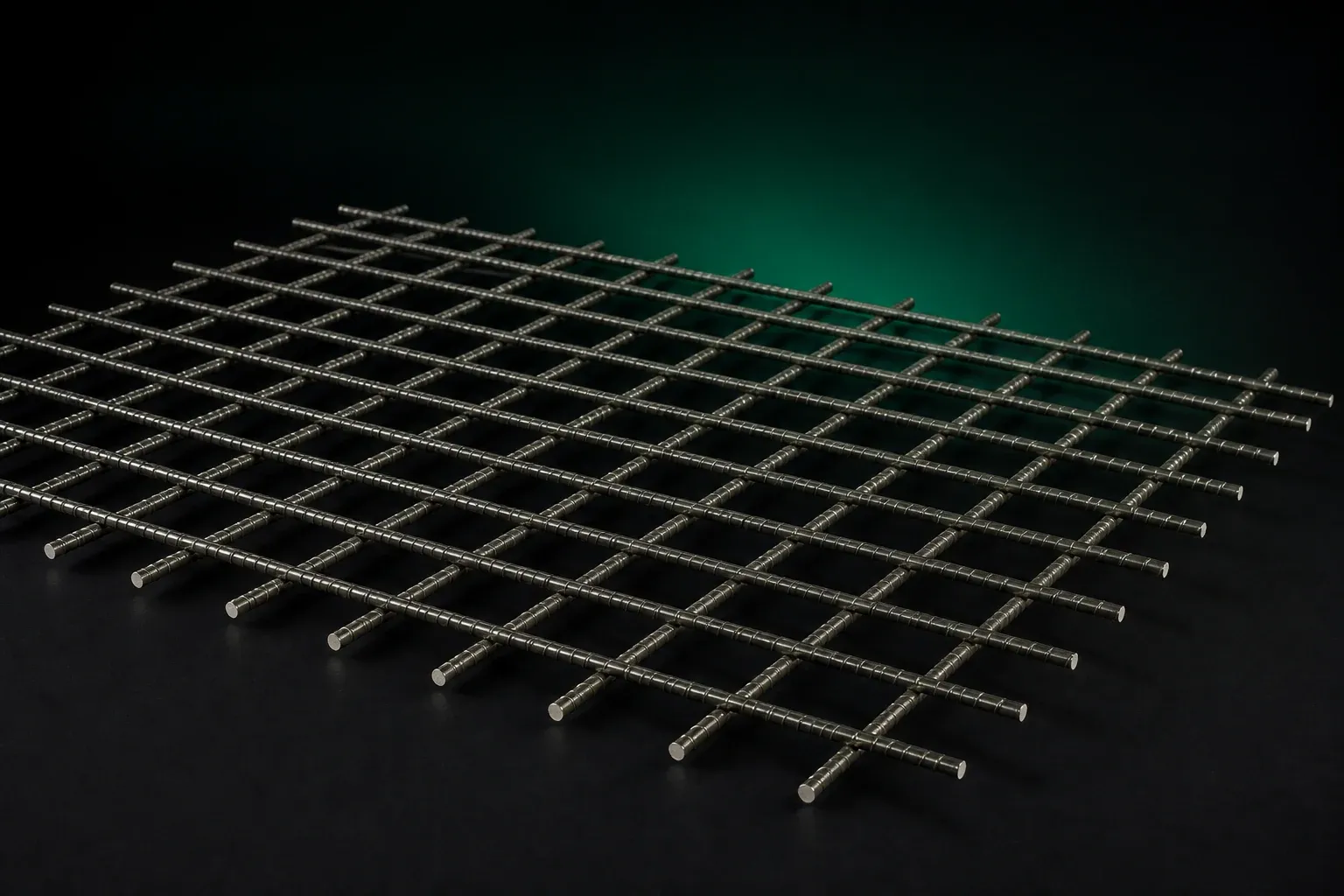
Ø 6 – 12 mm · bent to spec - Welded meshes
Pre-tied flat meshes for slab decks, ground beams, retaining wall refurbishment and curtain walls.
Ø 6 – 12 mm · 50 × 50 to 200 × 200 mm grid - Custom shapes
Custom curves, hooks and laminations within the limits of continuous-fibre production — co-engineered with the design office.
Project-specific
Continuous fibres,
continuous lengths.
Conventional FRP rebar is made in two stages: pultrusion of the core, then mechanical application of the surface ribs. The process breaks fibres and limits bar length. Our Nidletrusion process forms the anchorage profile in a single continuous run. Fibres remain intact, lengths are effectively unlimited, and the bar carries more fibre by mass than the FRP it replaces.
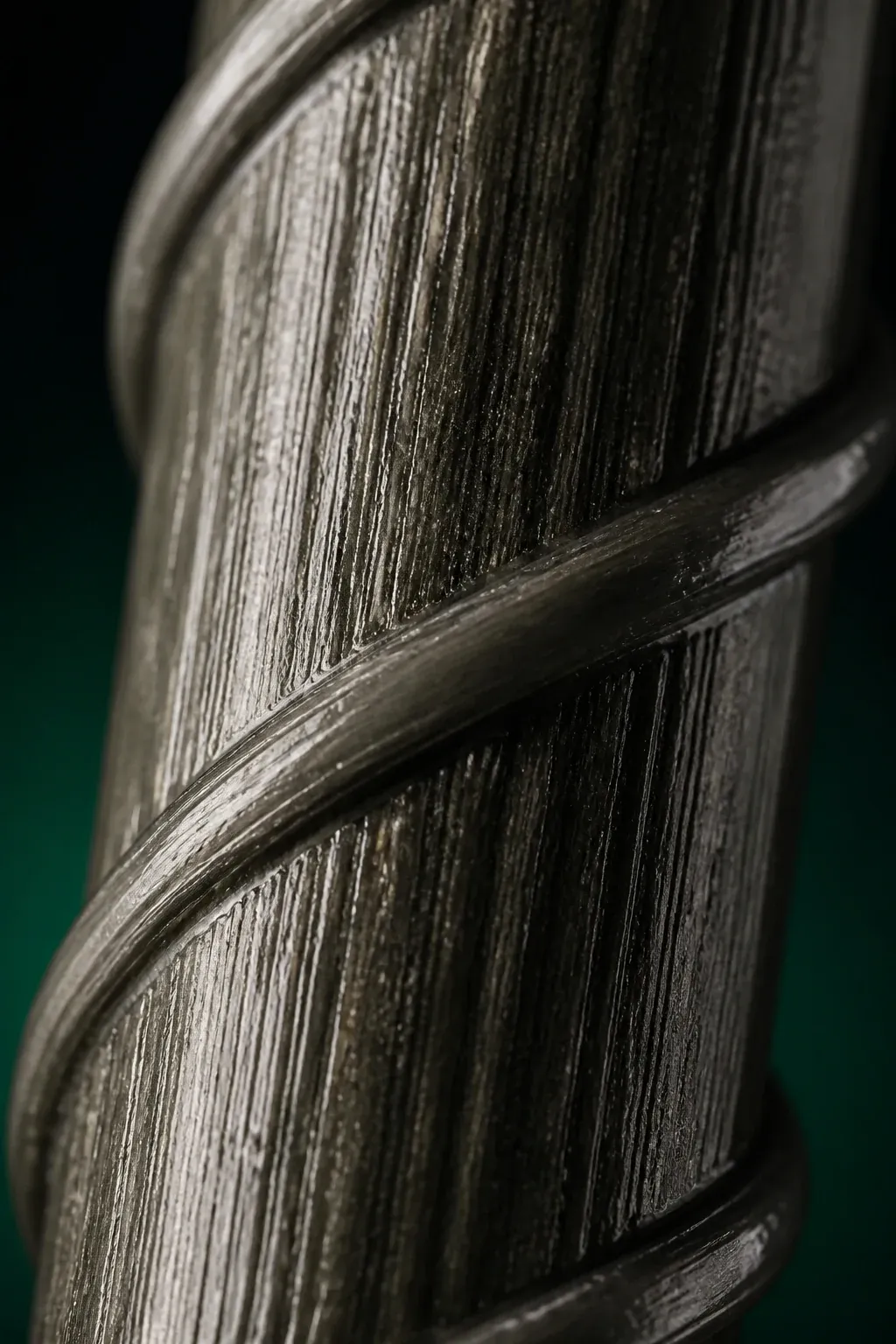
- A Helically profiled surface
A continuous raised profile that keys into the concrete around it — comparable to the ribbed steel rebar engineers know.
- B Continuous helical wrap
Formed in the same Nidletrusion run as the core, not glued on. No interruption to the fibres.
- C Continuous-fibre core
80 %+ glass fibre by mass, bound in a nano-epoxy resin matrix — not the polyester resin used in conventional FRP.
- 01Continuous fibres
E-glass roving drawn from spools, never cut.
- 02Resin bath
Nano-epoxy impregnation — full saturation, no voids.
- 03Helical winding
Anchorage profile formed in the same continuous run.
- 04Cure & inspect
Thermal cure, cooling and dimensional check.
GFRP is not a universal replacement for steel. It is a specialised solution for environments where corrosion drives lifecycle cost.
What you'll
find here.
Same product, three different conversations. Skip to the part of this page that matters to you — or open the full path for your role.
- 01 PROJECT ENGINEERSSpec sheets, on hand.
Full technical specification, the European Technical Assessment ETA 23/0523 (EAD 260023-00-0301), BIM family and per-diameter mill test certificates.
Jump to the spec - 02 DEVELOPERS · CONTRACTORSThe commercial case.
Lifecycle cost compared to steel, three reference projects and the sustainability story for LEED, BREEAM and DGNB.
Open the developer's path - 03 DEALERS · DISTRIBUTORSSamples & partnership.
Sample bundles to evaluate, regional partnership terms and the onboarding flow from enquiry to first order.
Open the dealer's path
The material
in numbers.
The values below are independently verified. Mill test certificates, the European Technical Assessment and the EPD are available on request.
The diameter
range, in full.
From Ø 6 mm in continuous coils, to Ø 16 mm structural bars. Smaller diameters come on continuous spools — fewer joints, less waste, faster installation. Each shipment carries its mill test certificate.
Values typical at 23 °C. Tensile strength decreases as bar diameter increases. Bendable diameters: Ø 6 – 12 mm. Mill test certificate supplied per shipment.
Certified, on file.
Every shipment carries its mill test certificate. The product itself is certified under the Slovak technical approval body and the European Technical Assessment.
- TSÚS · SKin force since 2022Slovak Building Approval
National technical approval, with annual surveillance audit of the Galanta manufacturing facility.
View certificate - ETA · EUETA 23/0523European Technical Assessment
First ETA for GFRP rebar in Europe. A recognised certification that lets engineers use it in CE-marked submissions.
View ETA - EPDEN 15804 +A2Environmental Product Declaration
EuCIA-verified. Reports cradle-to-gate carbon and the full lifecycle dataset.
Download EPD - MILL CERTper shipmentMill test certificate
Tensile, modulus and bond test results from the batch the bars were drawn from.
Sample · PDF - BIMIFC · RevitBIM family
Generic Revit family with the full diameter range. IFC export available on request.
Download family - STANDARDSISO 10406-1International design codes
Practice references: ACI 440.11-22, CSA S806/S807, fib Model Code 2020, ISO 10406-1.
Reference index
GFRP rebar, in depth.
What buyers ask first.
What is GFRP rebar?
What is the tensile strength of GFRP rebar?
What diameters does GFRP rebar come in?
How long does GFRP rebar last?
Is GFRP rebar approved in Europe?
How much CO₂ does GFRP rebar save vs. steel?
A three-step pilot —
to test it,
not commit to it.
We join projects as a partner, not a supplier. The first step is simply checking whether GFRP fits the element — not a commitment to switch.
- 01Technical workshop
Half-day with your engineering team. Design assumptions, detailing approach, code-compatible documentation.
- 02Sample delivery
Physical material samples and a bill-of-materials comparison — steel vs. GFRP for the same element.
- 03Pilot pour
One documented pour, with installation feedback, post-pour review and a scaling roadmap for the next elements.
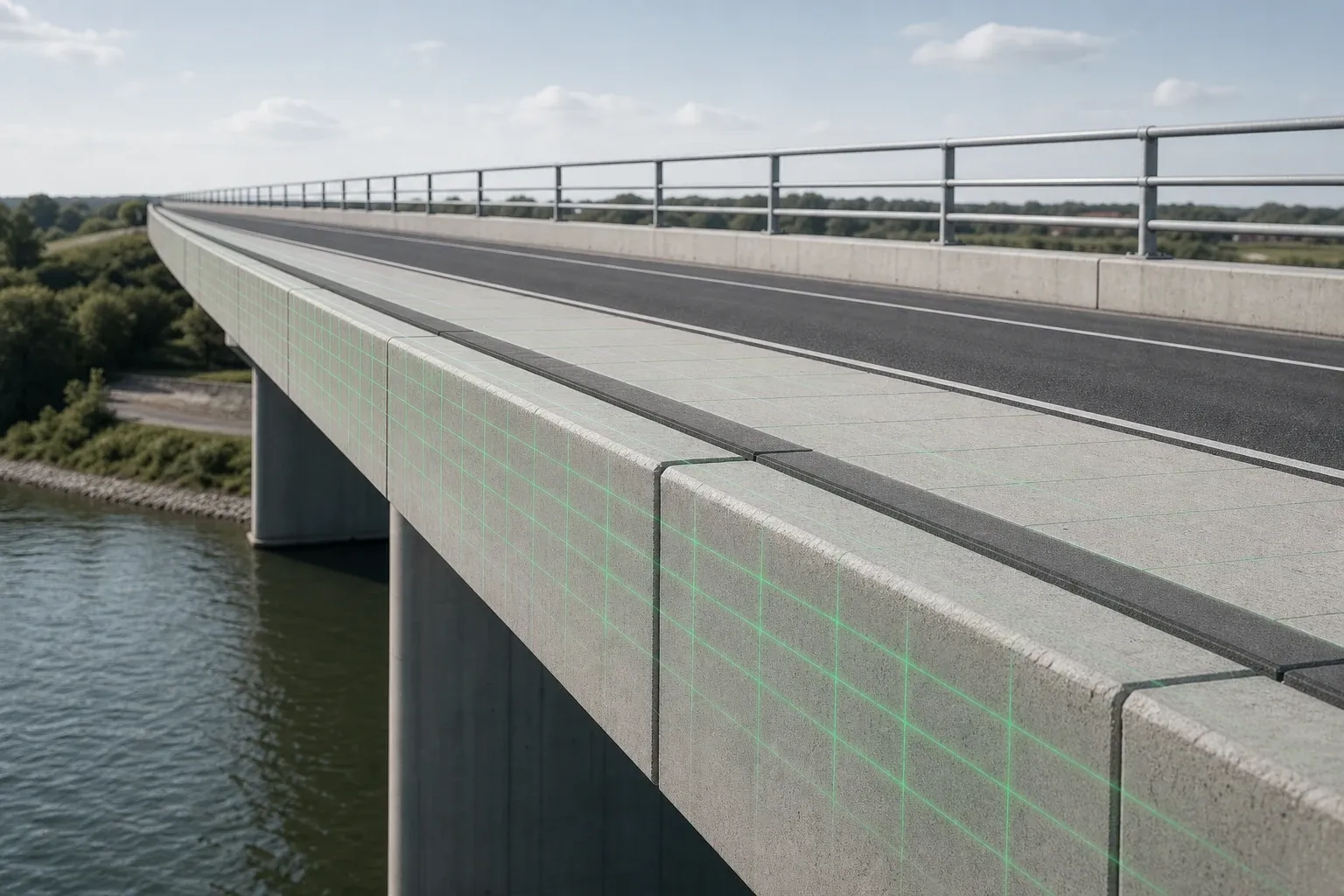
Suitable first-pilot elements: bridge deck sections · parapets · drainage channels · retaining walls · roadside slabs.

